All HSK-related information on this webpage is sourced from the Chinese Tests Service Website.
Original source: www.chinesetest.cn.
With the continued development of international Chinese language education, learners’ goals and usage contexts have become increasingly diverse, placing higher demands on the systematicity and precision of Chinese language proficiency assessment. Since 2021, the HSK has undergone a comprehensive optimization and revision process. Drawing on years of theoretical research and extensive global surveys, this process has gradually led to the establishment of a new framework based on a “three tiers, nine levels” structure—HSK 3.0. This system provides a more continuous and clearly defined pathway for the development of Chinese proficiency, allowing for a more accurate reflection of learners’ abilities at different stages.
HSK 3.0 is developed in accordance with the Chinese Proficiency Grading Standards for International Chinese Language Education and assesses candidates’ abilities from both linguistic knowledge and language use perspectives. The examination evaluates mastery of core language elements such as pronunciation, vocabulary, grammar, and Chinese characters, while also emphasizing the ability to comprehend and express meaning in authentic contexts and to accomplish communicative tasks. In this way, it embodies a “use-oriented” approach to language assessment.
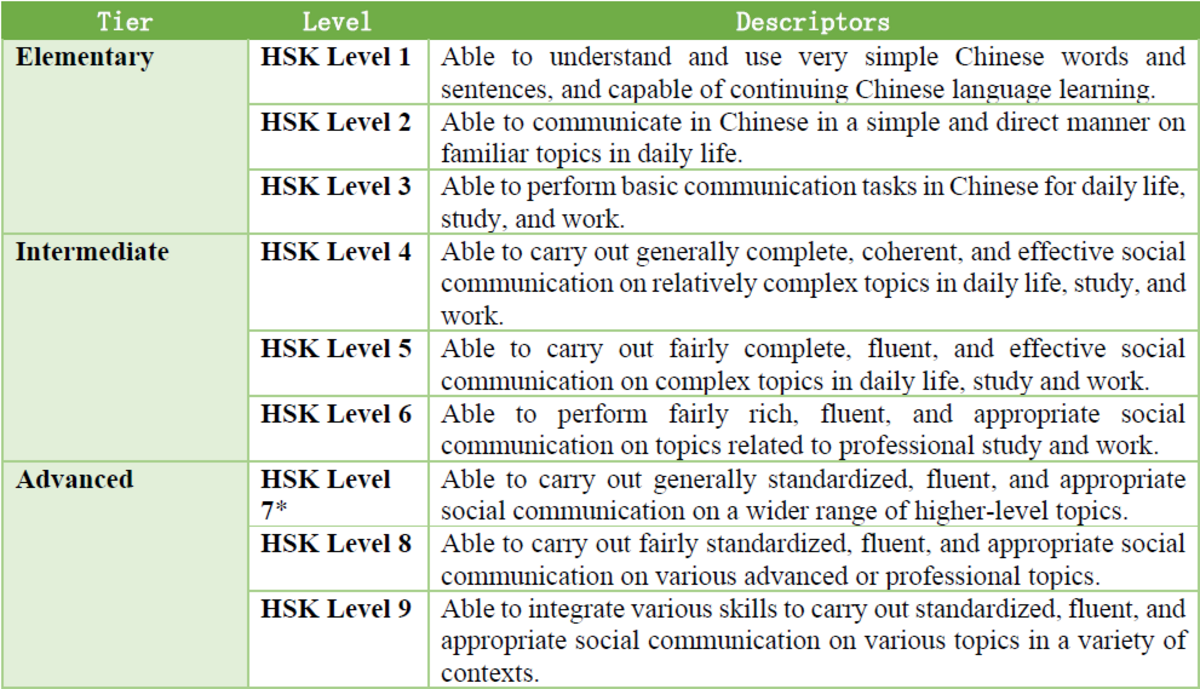
In terms of level design, HSK 3.0 is divided into three tiers—basic, intermediate, and advanced—comprising a total of nine levels. These levels cover a wide range of needs, from basic daily communication to advanced academic and professional expression. Each level places different emphases on test content, proficiency requirements, and application contexts, offering learners clear guidance for learning progression and reliable benchmarks for assessment.
At present, the development of HSK 3.0 has been completed, and the first official examinations are expected to be administered in the second half of 2026, subject to official announcements. During the transition period, the new system will be introduced gradually to better serve learners of Chinese worldwide.
HSK results are an important indicator of Chinese language proficiency and enjoy broad recognition and practical value. They serve not only as a key reference for studying in China, applying for scholarships, and participating in exchange programs, but also play a significant role in China-related employment, teaching evaluation, and academic research. In this way, the HSK meets learners’ diverse needs in academic pursuits, professional development, and intercultural communication.
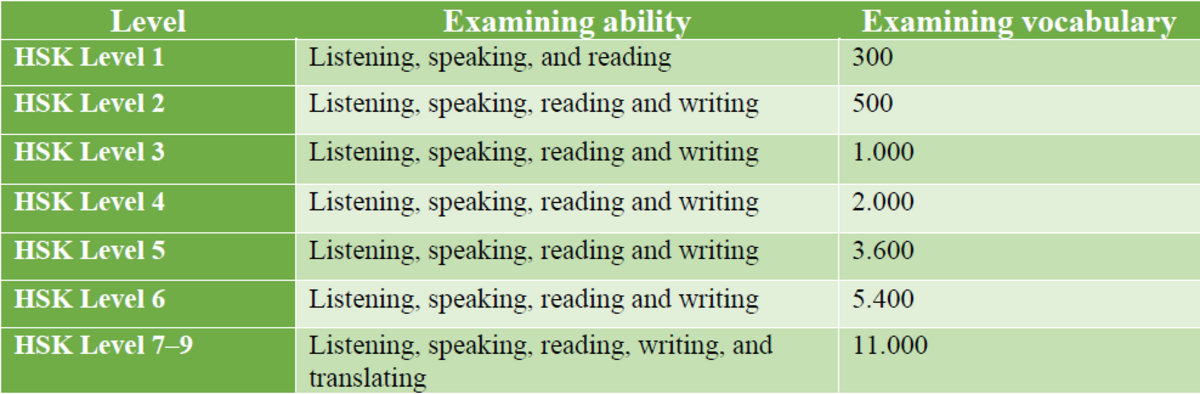
System Restructuring: The former six-level structure has been upgraded to a new ‘Three-tier, Nine-level’ system, with the addition of HSK Levels 7-9. This establishes a comprehensive Chinese proficiency assessment framework that covers elementary, intermediate, and advanced levels.
Competence Orientation: HSK follows the principle of assessing Chinese communicative competence by comprehensively evaluating the five language skills of listening, speaking, reading, writing, and translation.1
Learning for Application: HSK content has been thoroughly optimized to reflect more real-life communicative scenarios, enrich assessment dimensions, expand the range and depth of topics, and provide a multi-dimensional evaluation of test takers’ Chinese communicative competence.
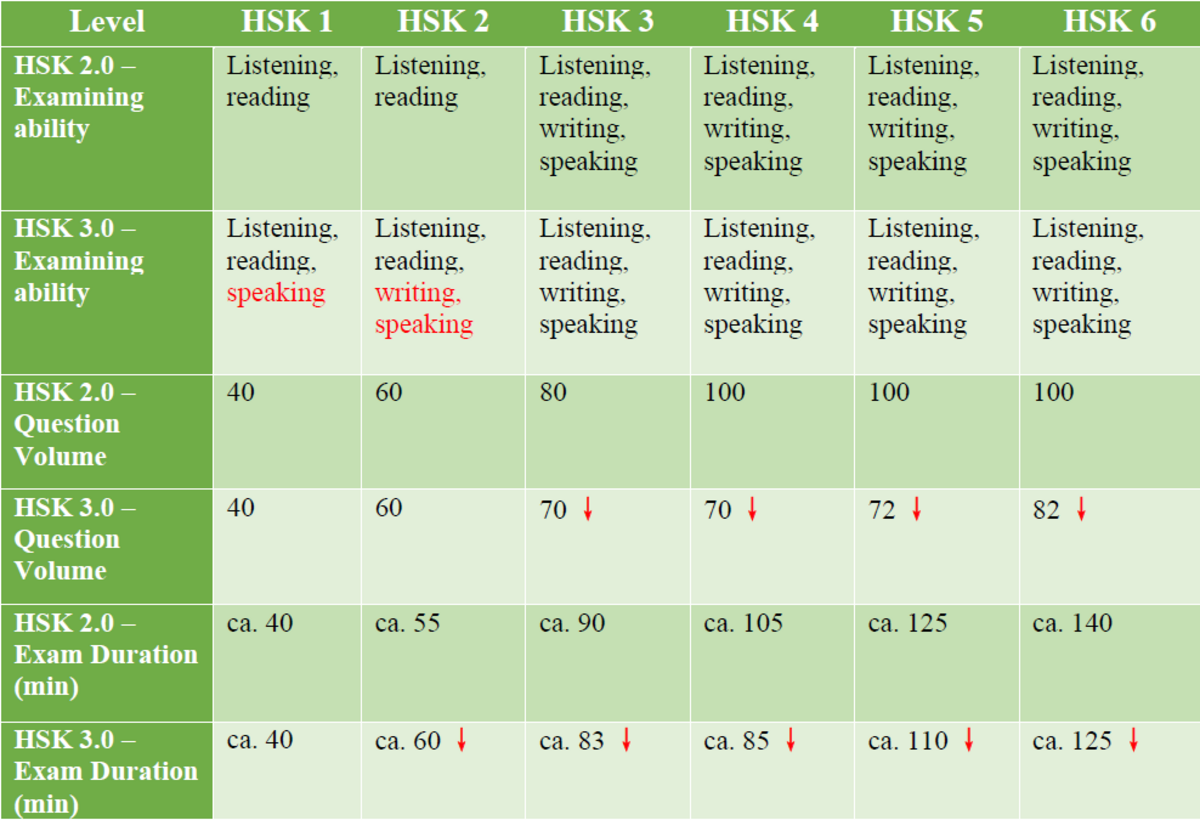
Enhanced Experience: The question types have been refined, the number of questions and total test duration reduced, and the listening speed adjusted to provide test takers with a brand-new testing experience.
*HSK Levels 7-9 are assessed in a single test, with the specific level determined according to the test results.
The new HSK exam syllabus comprises five sections: task, topic, vocabulary, grammar, and Chinese characters. It aligns communicative topics and tasks with measurable language indicators.
The five components complement one another, not only serving as a guideline for test preparation, but also playing a critical role in connecting teaching and learning with real-world application.
Real-world language communication helps learners transition from “learning Chinese” to “using Chinese”, that is, “acting with language”.
Download the Task Outline
*The documents are provided entirely in Chinese. If needed, please use translation software or AI tools to translate the relevant sections into your target language.
The vocabulary syllabus outlines the key areas of focus for each level of the exam, allowing learners to study and prepare more effectively.
Download Vocabulary Outlines:
Vocabulary Outline HSK 1
Vocabulary Outline HSK 2
Vocabulary Outline HSK 3
Vocabulary Outline HSK 4
Vocabulary Outline HSK 5
Vocabulary Outline HSK 6
Vocabulary Outline HSK 7-9
*The documents are provided entirely in Chinese. If needed, please use translation software or AI tools to translate the relevant sections into your target language.
The tiered descriptions of grammar points at each level guide learners to organize grammatical units such as words into appropriate structures to complete corresponding language tasks such as listening, speaking, reading, writing, and translation.
Download Grammar Outlines:
Grammar Outline HSK 1
Grammar Outline HSK 2
Grammar Outline HSK 3
Grammar Outline HSK 4
Grammar Outline HSK 5
Grammar Outline HSK 6
Grammar Outline HSK 7-9
*The documents are provided entirely in Chinese. If needed, please use translation software or AI tools to translate the relevant sections into your target language.
The assessment scope for recognizing and writing characters at each level allows learners to improve their Chinese character Writing skills by adopting methods such as recognizing more characters and writing fewer, or recognizing characters first and then writing them, based on their own abilities.
Download Chinese Outlines:
Chinese Outline HSK 1
Chinese Outline HSK 2
Chinese Outline HSK 3
Chinese Outline HSK 4
Chinese Outline HSK 5
Chinese Outline HSK 6
Chinese Outline HSK 7-9
*The documents are provided entirely in Chinese. If needed, please use translation software or AI tools to translate the relevant sections into your target language.
The basic scope and content of learners’ oral and written communication in Chinese embody the idea that “language is life”.
Download Topic Outlines:
Topic Outline HSK 1
Topic Outline HSK 2
Topic Outline HSK 3
Topic Outline HSK 4
Topic Outline HSK 5
Topic Outline HSK 6
Topic Outline HSK 7-9
*The documents are provided entirely in Chinese. If needed, please use translation software or AI tools to translate the relevant sections into your target language.
New HSK Course
New HSK Textbook Series. The course is learner-centered, designed to focus on both HSK test preparation and Chinese language learning. It aims to promote reinforcement across testing, teaching, learning, and practical application. The lesson content, vocabulary, and language points are aligned with the new HSK syllabus, covering topics, tasks, vocabulary, grammar, and Chinese characters. Additionally, the series utilizes multi-dimensional digital resources to enhance teaching, including supportive digital textbooks and other learning materials. New HSK Textbook Series comprehensively covers HSK Levels 1-9, including core courses and practice manuals.
Please register for the test at www.chinesetest.cn. Test takers can choose between the traditional paper-based exam and the computer-based test, according to their preference. Advanced facial recognition technology and security measures in the testing room work together to ensure fairness and order throughout the exam.
Test takers can view their results on www.chinesetest.cn either two weeks after completing the computer-based test or one month after the paper-based test. The Center for Language Education and Cooperation (CLEC) of the Ministry of Education of the People’s Republic of China issues HSK result reports, which are valid for two years from the test date.
The HSK examination is a standardised language test, which assesses the Chinese language skills of Chinese learners. The examination is held in certified examination centres worldwide. The Confucius Institute Munich offers the written examinations four times per year, and the oral examination once per year.
We are the first test centre in Germany to offer the computer-based examination for levels 5 to 9.